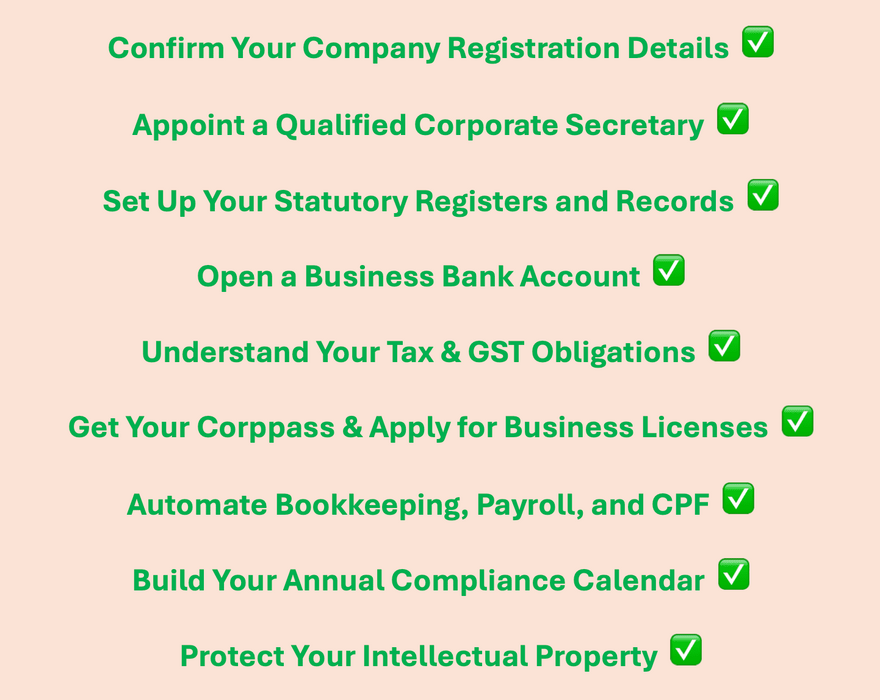
Singapore has long held its crown as the "World's Easiest Place to Do Business". However, as we navigate through 2026, the company formation Singapore landscape is shifting from simple administration to strategic compliance. Here’s the thing: most investors or entrepreneurs have this twisted idea that registration of their business simply requires hitting the submit button on the registration portal.
After all, it only takes 15 minutes. This is where they get it all wrong. The reality of the matter is that the preparation required to build a compliant, tax-efficient, and scalable business in today’s economy has never been more critical.
At Savvy, we have guided hundreds of entrepreneurs through this journey. We’ve seen firsthand that the difference between a business that thrives and one that gets tangled in regulatory red tape lies in the details. It all boils down to the choice of SSIC codes, the structure of the board, and the foresight to plan for 2026’s updated tax incentives.
This guide is designed to take you from your initial spark of an idea to a fully operational, legally registered entity.

Why Singapore Remains the Ultimate Business Hub in 2026
As regards company formation Singapore, it's important to note that Singapore isn't just a dot on the map. No. It is a global gateway. For startups and international entrepreneurs, it offers a combination of stability and growth that is hard to replicate elsewhere.
The 2026 Economic Edge
In the 2026 Budget, the Singapore government reaffirmed its commitment to the "Smart Nation" initiative. It introduced the 40% Corporate Income Tax Rebate (capped at $30,000) for active companies. This is a direct injection of liquidity designed to help small-to-medium enterprises (SMEs) offset rising operational costs.
Tax Exemptions for New Start-Ups (SUTE)
At Savvy, we often remind our clients that Singapore’s tax system is "progressive" for businesses. The Start-Up Tax Exemption (SUTE) scheme is one of the most generous in the world. For your first three consecutive Years of Assessment (YAs):
- 75% exemption on the first $100,000 of normal chargeable income.
- A further 50% exemption on the next $100,000.
Legal Transparency and IP Protection
As we move further into the decade, intellectual property (IP) has become a business's most valuable asset. Singapore’s legal framework, updated in 2026 to include stricter Corporate and Accounting Laws, ensures that your trademarks, patents, and shareholder rights are protected by a world-class judiciary. This transparency is exactly what Venture Capital (VC) investors look for when deciding where to deploy capital.
Key Considerations Before You Register
Before we get into the paperwork, we need to address the "DNA" of your company. Decisions made here will affect your taxes, your personal liability, and your ability to hire or raise funds.
Choosing the Right Business Structure
Choosing a structure is not a "one size fits all" decision. At Savvy, we help you weigh the pros and cons of each.
Private Limited Company (Pte Ltd)
This is the gold standard. It is a separate legal entity, meaning your personal assets are protected.
- Pros: Limited liability, 100% foreign ownership allowed, and high credibility with banks.
- Cons: Stricter compliance requirements (annual audits or filings).
Sole Proprietorship
This is the simplest form of business but also the riskiest.
- Pros: Low cost and minimal paperwork.
- Cons: Unlimited Personal Liability. If the business is sued or goes into debt, your personal house, car, and savings are at risk.
Limited Liability Partnership (LLP)
Commonly used by professional services like lawyers or accountants. It combines the benefits of a partnership with limited liability.
The "SSIC" Code: Your Business Identity
The Singapore Standard Industrial Classification (SSIC) code tells the government what your business actually does. At Savvy, we recommend choosing your primary code with extreme care. Why is this the case? Well, there are inherent risks.
Selecting codes related to "Finance," "Education," "Media," or "Real Estate" often triggers a secondary review by other government agencies (like the Monetary Authority of Singapore or the Ministry of Education). This can delay your registration by 14 to 60 days.
- The Strategy: If your core revenue comes from software development, stick to a Technology code rather than a Financial one, even if your software is intended for the fintech sector.
Minimum Requirements for Company Formation in Singapore
To register, you must meet these criteria:
- At least one shareholder: This can be an individual or a corporation.
- At least one "Ordinary Resident" Director: A Singapore Citizen, Permanent Resident, or EntrePass holder.
- A qualified Company Secretary: Must be appointed within 6 months of incorporation.
- A local registered office address: It must be a physical address (no P.O. boxes). However, the Home Office Scheme allows for residential addresses in certain cases.
- Minimum paid-up capital of $1: While $1 is the legal minimum, we usually suggest a higher amount (say $1,000 to $10,000) to appear more credible to banks.
Common Challenges (And How to Avoid Them)
The road to registration/company formation Singapore is often paved with good intentions but poor documentation. Here is what usually goes wrong and how we help you navigate it:
The Local Director Trap
Foreign founders often struggle to meet the "Resident Director" requirement. Some turn to "informal" nominee arrangements with friends or distant acquaintances. This is a high-risk strategy. In 2026, ACRA increased its oversight of "shadow directors."
If your nominee director is found to be unqualified or negligent, it could lead to the striking off of your company. We provide professional Nominee Director services to ensure you stay compliant without compromising your operational control.
Tightening of KYC and AML Rules
In line with global standards, Singapore has tightened its Know Your Customer (KYC) and Anti-Money Laundering (AML) regulations. If your documentation for directors or shareholders (such as proof of address or notarized passports) is even slightly inconsistent, ACRA will reject the filing. We conduct a "pre-audit" of your documents to ensure they meet the 2026 standards before submission.
The Business Banking Hurdle
This is the most common shock for new founders. While your company might be registered in 48 hours, opening a corporate bank account in Singapore now takes anywhere from 2 to 8 weeks. Traditional banks require rigorous "Source of Wealth" checks. We maintain relationships with both traditional banks (DBS, OCBC, UOB) and digital-first neo-banks to help streamline this process.
The Step-by-Step Guide to Registration
Step 1: Name Reservation (BizFile+)
Your company name must be unique. We submit your proposed name to BizFile+ (ACRA’s portal).
- Avoid: Generic terms, trademarks of other companies, or words like "Bank," "Insurance," or "University" unless you have the relevant licenses.
- Validity: Once approved, the name is reserved for 120 days.
Step 2: Preparing the Constitution
The Company Constitution is the legal document that governs how your company is run. It outlines the rights of shareholders, the powers of directors, and the process for dividends. While you can use ACRA’s "Model Constitution," many of our clients prefer a customized version, especially if they are planning to raise series-level funding in the future.
Step 3: Formal Filing and Approval
Once all directors and shareholders have digitally signed the Form 45 (Consent to Act as Director) and Form 45B (Consent to Act as Secretary), we file the application. In most cases, the Certificate of Incorporation is issued via email within 1 to 2 business days.
Step 4: Post-Registration Obligations (The First 30 Days)
Registration is just the beginning of your legal life in Singapore.
- Issuing Share Certificates: You must formally issue certificates to your shareholders.
- Opening the Bank Account: As mentioned, do this immediately. You cannot legally "operate" or hire until you have a way to process capital.
- Registering for GST: This is mandatory only if your taxable turnover exceeds $1 million. However, if you are an exporter, you might choose Voluntary GST Registration to claim back the taxes you pay on business inputs.
Staying Compliant in 2026: The New Rules of the Game
The regulatory environment has evolved. In 2026, "paper-based" compliance is a thing of the past. Singapore has fully embraced a digital-first approach.
The RORC Mandate
You are legally required to maintain a Register of Registrable Controllers (RORC). This document identifies the "Ultimate Beneficial Owners" of the company. In 2026, the penalties for failing to keep this register updated (or failing to file it with ACRA) have increased significantly. Transparency is the theme of the year.
The 6-Month Secretary Rule
Every company must appoint a qualified Company Secretary within six months of incorporation. This person is the "compliance officer" of your business. They ensure you meet deadlines for your Annual General Meeting (AGM) and the filing of your Annual Returns.
Annual General Meetings (AGMs) and Annual Returns (AR)
- AGMs: Must be held within 6 months after your Financial Year End (FYE).
- AR Filing: Must be filed within 7 months after your FYE.
- The 2026 Digital Shift: All filings must now be authenticated via Singpass. For foreign directors without Singpass, a registered filing agent (like Savvy) must facilitate the process.
Financial Management: Maximizing Your 2026 Incentives
Singapore’s tax system is designed to reward growth, but you have to know how to claim those rewards.
Choosing Your Financial Year End (FYE)
Your FYE doesn't have to be December 31st. At Savvy, we often suggest a date that maximizes your tax-free period under the SUTE scheme. For example, if you incorporate in July, setting your FYE to June 30th gives you a full 12 months for your first "Year of Assessment."
The Move Toward Monthly Bookkeeping
With the Inland Revenue Authority of Singapore (IRAS) moving toward more frequent digital reporting, we strongly advise moving away from "shoe-box" accounting. Maintaining monthly digital records ensures you are ready for the 2026 Corporate Tax Rebate and provides the financial clarity needed to secure business loans.
How Professional Support Simplifies the Journey
The reality of company formation in Singapore is that while the registration is fast, the compliance is relentless. Most founders find that trying to manage the Nominee Director requirements, the Company Secretary obligations, and the AML documentation on their own leads to months of delays and potential fines.
We act as your local partner, taking the administrative weight off your shoulders so you can focus on your product and your customers. We provide:
- Seamless Incorporation: Handling everything from name reservation to the final BizFile lodgment.
- Corporate Secretarial Services: Acting as your gatekeeper for all ACRA and IRAS deadlines.
- Nominee Director Solutions: Providing reliable, professional resident directors to satisfy legal requirements while you maintain 100% operational control.
- Accounting & Tax Filing: Leveraging the latest 2026 tax incentives to ensure your business remains as profitable as possible.
In conclusion, Singapore remains the most vibrant, stable, and business-friendly environment in the world as we move through 2026. However, the "ease of doing business" comes with a caveat: Singapore rewards those who follow the rules.
By planning your structure carefully, selecting the right partners, and staying ahead of compliance deadlines, you aren't just registering a business, you are building an asset. Whether you are a solo founder or a scaling multinational, the steps you take today will define your success in the years to come.
Ready to turn your idea into a Singapore reality? Contact us today to speak with our incorporation specialists. Let us handle the complexity so you can build the future.