Starting a business in Singapore is a dream for many. And why not? It’s a global powerhouse and a gateway to the fastest-growing markets on the planet. Add reasonable taxation - and you get paradise for entrepreneurs, founders and investors. But here is the reality: Singapore company setup is the easy part.
The real work, the part that determines whether you thrive or get buried in paperwork, starts the day after you receive your Unique Entity Number (UEN).
Most founders focus entirely on the launch, the branding, and the first sale. They forget about the invisible scaffolding that keeps a business standing: Corporate Compliance. In Singapore, compliance isn't a friendly suggestion. It is a strictly enforced legal framework.
If you want to build a serious, scalable business, you need to understand this landscape. This isn't just about filing papers; it’s about protecting your personal liability, staying on the right side of the Inland Revenue Authority of Singapore (IRAS), and keeping your corporate reputation spotless.
Here is the comprehensive guide on exactly what to expect when setting up a company in Singapore and how to stay compliant for the long haul.

Why Singapore Is a Leading Business Hub
There’s a reason why thousands of entrepreneurs flock here every year. It isn't just the iconic skyline or the world-class airport. It’s the "pro-business" DNA woven into the country's laws.
1. Political and Economic Stability
In a world of fluctuating markets and shifting political regimes, Singapore is a rock. You don't have to worry about sudden, radical policy shifts that might jeopardize your ownership or your capital. This predictability is worth its weight in gold for long-term planning.
2. A Business-Friendly Regulatory Framework
The Singapore government doesn't see itself as an obstacle to your business; it sees itself as a partner. The Accounting and Corporate Regulatory Authority (ACRA) has digitized almost everything. You don’t need to wait weeks for a physical certificate; everything happens in the cloud.
3. Attractive Corporate Tax Rates
Singapore operates on a territorial basis of taxation. This means companies are taxed on underived or received income in Singapore. With a headline corporate tax rate of 17%, it’s already competitive. However, for new startups, the Tax Exemption Scheme can bring that effective rate down significantly for the first three years of assessment.
4. Global Reputation
Having "Singapore" in your business address carries weight. It tells investors, banks, and global clients that you operate under a high standard of transparency and the rule of law. It’s an immediate "trust signal" in international trade.
But there is a catch. Singapore is efficient precisely because it is regulated. The government makes it easy to start, but they expect you to play by the rules. This is where most people trip up.
They see the "ease" and assume "no effort." At Savvy, we help founders bridge that gap. We ensure that the efficiency of your setup doesn't lead to expensive compliance headaches later.
Understanding the Singapore Company Setup Process
Before you hit "submit" on your registration, you have to make a few critical choices that will affect your tax bill and your legal protection for years to come.
Choosing the Right Business Structure
Most entrepreneurs we talk to go straight for the Private Limited Company (Pte Ltd). While there are other options like Sole Proprietorships or Limited Liability Partnerships (LLP), the Pte Ltd is the gold standard for several reasons:
- Limited Liability: This is the most important part. The company is a separate legal entity. If the business hits a rough patch or faces a lawsuit, your personal assets—your house, your savings, your car—are safe.
- Scalability: It is much easier to raise capital, issue shares to employees, or bring on venture capital with a Pte Ltd structure.
- Perpetual Succession: The company exists independently of its owners. If a shareholder leaves or passes away, the company continues to breathe.
- Tax Benefits: Only Pte Ltd companies have access to the full suite of startup tax exemptions and incentives provided by IRAS.
Key Requirements for Incorporation
To get the green light from ACRA, you need to satisfy these five fundamental requirements:
- At least one Resident Director: This is often the biggest hurdle for foreign founders. You must have at least one director who is "ordinarily resident" in Singapore. This means they are a Singapore Citizen, a Permanent Resident, or an EntrePass/Employment Pass holder. If you don't have one, you will need a Nominee Director service.
- Shareholders: You need at least one, and it can be a person or another corporate entity. You can have up to 50 shareholders for a private company.
- Company Secretary: You must appoint a qualified secretary within six months of incorporation. In Singapore, this isn't an administrative assistant; it’s a legal officer responsible for regulatory filings.
- Registered Business Address: No P.O. boxes allowed. You need a physical office address in Singapore where legal documents can be served.
- Minimum Paid-up Capital: You can technically start with as little as $1 SGD. However, if you are applying for work passes (like an EP), you may need a higher capital injection.
Documents Needed for Company Registration
Don't wait until the last minute to gather these. To avoid delays, you’ll need:
- Identification: High-resolution copies of passports and proof of residence for all foreign directors/shareholders, or Singpass details for locals.
- Company Constitution: This is your "operating manual." It defines how the company is governed, how shares are transferred, and how meetings are called.
- Description of Business Activities: You must select up to two Singapore Standard Industrial Classification (SSIC) codes that best describe what your company actually does.
At Savvy Platform, we handle the heavy lifting here. We prepare these documents, ensure they meet ACRA standards, and submit them so you can focus on your first customer rather than your first filing.
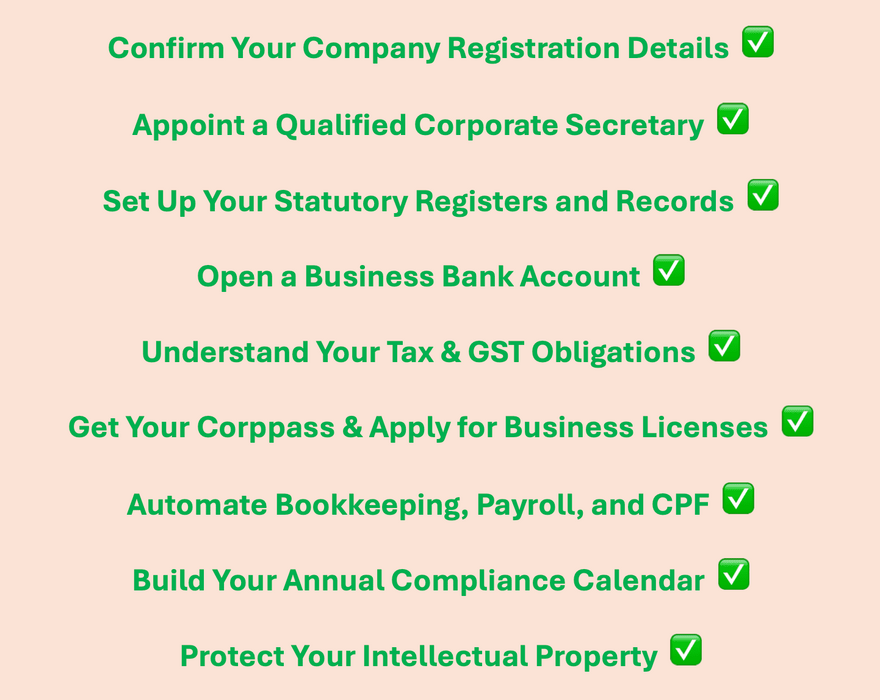
Corporate Compliance: What Happens After Incorporation?
Congratulations, you’re incorporated. You have your BizFile and your UEN. Now, the real work begins. In Singapore, company setup is the "sprint," but compliance is the "marathon."
1. Appointment of a Company Secretary
As mentioned, this is a legal mandate. Your Company Secretary is the guardian of your corporate records. Their job is to ensure the company doesn't fall out of favor with the law.
They prepare board resolutions, maintain the statutory registers, and ensure that any changes in the company (like a new director or a change in address) are reported to ACRA within the strict 14-day or 30-day windows.
2. Maintaining Statutory Registers and Records
You are legally required to keep "books." These aren't just for your internal use; they are the official record of the company’s life. You must maintain:
- Register of Members: Who owns which shares and when they got them.
- Register of Directors: Who is running the show?
- Register of Registrable Controllers (RORC): This is a newer, critical requirement to prevent money laundering. It identifies the "warm bodies" who ultimately control the company.
- Minutes of Meetings: Every time your board makes a major decision, it must be recorded in writing and kept in the minute book.
3. Annual General Meetings (AGM)
Every Pte Ltd must hold an AGM. This is a formal meeting where you present your financial statements to the shareholders. It’s about transparency. While some private companies can be exempt from holding an actual physical meeting, you still have to go through the legal motions of "laying the accounts" and approving them.
4. Annual Filing Requirements
This is the part that keeps founders up at night, but it shouldn't. There are two main agencies you need to satisfy every year:
- ACRA (Annual Returns): You must file your annual return within 7 months after your Financial Year End (FYE). This confirms that your company information is up to date and your finances have been reviewed.
- IRAS (Corporate Tax): Within 3 months of your FYE, you must file your Estimated Chargeable Income (ECI). This tells the government how much tax you expect to pay.
- Form C / C-S: This is your final tax return, usually due by November 30th of the following year.
Missing these deadlines is expensive. ACRA and IRAS issue automatic fines for late filings. If you ignore these, you could face court summons or even the disqualification of your directors.
Common Compliance Challenges for New Businesses
Why do so many smart founders fail at compliance? It’s rarely because they want to break the rules. Usually, it’s one of three things:
The "Date" Problem
Singapore doesn't have a universal tax year for everyone. Your deadlines depend on your specific Financial Year End. If you choose December 31st as your FYE, your deadlines are different than if you chose March 31st. Many founders get confused by this "floating" schedule and miss their filings by weeks or months.
The Documentation Gap
Many entrepreneurs make big moves (they hire a new director, move into a bigger office, or issue shares to an investor), but they forget to file the resolution or notify ACRA. If it isn't recorded in the BizFile, it didn't legally happen. This causes massive problems during "due diligence" when you try to sell the company or get a bank loan.
The Resident Director Risk
Foreign founders often rely on a Nominee Director. If that director isn't professional or if the paperwork isn't tight, your company’s bank account could be frozen, or your registration could be cancelled. You need a partner you can trust.
How Professional Support Simplifies Your Life
You didn't start a business to become a legal clerk or a tax accountant. Your Singapore company setup was to change the world, build a product, or provide a service.
When you use a platform like Savvy, you aren't just buying software; you are buying peace of mind. Here is how we change the experience:
- Proactive Reminders: You don't need to remember your FYE deadlines. We do. We send you alerts long before a fine is even a possibility.
- Digital Convenience: No more stacks of paper. Sign your resolutions digitally, store your statutory records in a secure cloud, and access your corporate profile from anywhere in the world.
- Expert Oversight: When you have a question about whether a specific expense is tax-deductible or how to structure a share transfer, you have experts at your fingertips.
- Cost Efficiency: Hiring a full-time in-house compliance officer is expensive. Our platform gives you that same level of protection for a fraction of the cost.
Preparing for Long-Term Business Success
Think of compliance as the foundation of a skyscraper. You can't see the foundation from the street, but without it, the whole building falls over when the wind blows.
Strong corporate governance is an asset. If you ever want to:
- Attract Investors: They will look at your books. A messy compliance history is the fastest way to kill a deal.
- Get a Bank Loan: Banks in Singapore are incredibly strict. They will check your ACRA filings before they even talk to you about credit.
- Apply for Government Grants: The Singapore government offers massive support to startups (like the Enterprise Development Grant), but you must be in good standing to qualify.
By taking these steps seriously from day one, you aren't just "following rules"—you are building a "bankable" business. You are showing the world that you are a professional who respects the ecosystem.
Singapore is arguably the best place in the world to be an entrepreneur right now. The infrastructure is there, the capital is there, and the talent is there. But the price of admission to this ecosystem is a commitment to corporate compliance.
The process of Singapore company setup is straightforward when you have the right roadmap. Staying compliant is manageable when you have the right tools. From the moment you pick your company name to the moment you file your final tax return for the year, every detail matters.
Don't let the paperwork slow your momentum. Don't let a missed deadline become a stain on your corporate record. We are here to ensure that your Singapore journey is smooth, legal, and built for scale.
Are you ready to launch your vision or need to get your compliance back on track? At Savvy, we are ready to help you navigate the Singapore business landscape with ease.
Contact us today to see how we can simplify your Singapore company setup and keep you compliant every step of the way.